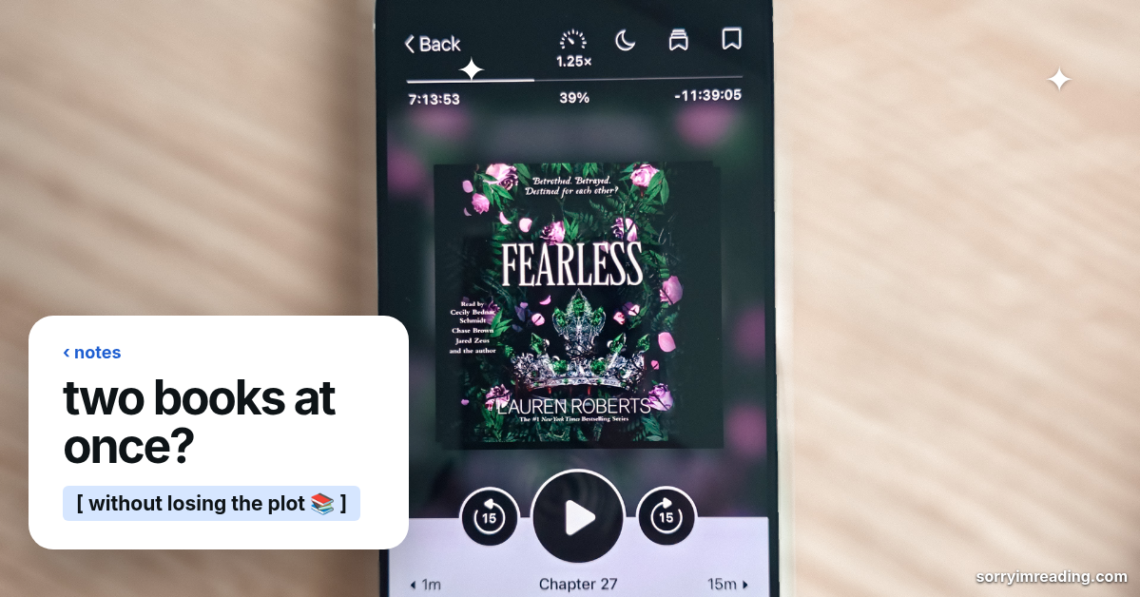
The fastest way to wreck a good reading mood is treating one book like a hostage situation. You loved it on Monday. Now it’s Thursday, and opening it feels like a chore.
Reading two books at once gives your reading experience another door, not another assignment. One book can take your full attention on a lazy Sunday. The other can handle that 20-minute bedtime slot. Two books at the same time can still feel easy when you want kisses, chaos, or a body on page one.
You don’t need a color-coded spreadsheet or eight open tabs in your brain. You need two books with different jobs, a simple approach known as interleaving books.
This post may contain affiliate links. If you make a purchase through these links, I may earn a small commission at no extra cost to you.
As an Amazon Associate I earn from qualifying purchases.
Key Takeaways
- Pair books with different genres, formats, settings, or emotional energy so their stories do not blur together.
- Give each book a clear job, such as a high-focus day book and an easier, more emotional night book.
- Switch at a clean stopping point, then use a small anchor or three-line note to quickly recover the plot and your feelings.
- Reading two books should protect your reading momentum and enjoyment, not become another obligation.
- Pause or DNF a book when it keeps feeling like work; your TBR does not need your loyalty.
Why Two-Book Reading Works for Mood Readers
Reading two books isn’t a comprehension flex. It’s permission to read the book that fits your actual brain that day.
Some nights, you want to sink into a complicated fantasy court with names you need to sound out twice. Other nights, you need a capable heroine, a hot mess of a man, and chemistry that gets moving before page 200. Both moods are real. Both deserve a book.
Give Each Book a Different Job
The easiest pairing is one book for feelings and one for focus.
Maybe your focus book is a dragon-heavy Romantasy with maps, political alliances, and a war coming from six directions. Your feelings book can come from a contrasting book genre, like a contemporary romance with a fake-dating setup and enough banter to make you grin into your pillow. That contrast changes the emotional demand of each session.
One asks for more cognitive effort. The other offers relief.
You can also pair a suspense story with a soft romance, or nonfiction on audio with fiction in print. The point isn’t reading more pages. It’s deliberately interleaving books to protect your reading momentum when one book isn’t matching your mood.
A Switch Can Save a Stalled Reading Mood
You are allowed to put down the 600-page fantasy when your brain has clocked out. A reading slump doesn’t mean the book failed. It means it needs a version of you with more patience.
Swapping books stops that miserable spiral where you avoid reading because the only book you “should” read sounds exhausting. Pick up the other one. Read 30 pages. Keep your reading habit fun.
The spiral often starts when we confuse commitment with obligation. Babe, no. This is supposed to be enjoyable.
Pair Books That Will Not Blur Together
Two books don’t automatically create plot confusion. Two books with similar names, similar settings, and similar brooding shadow kings? Okay, that can get messy.
Readers can pair fiction and non-fiction, or choose stories with different settings, stakes, and pacing.
A study of long-text comprehension describes how readers build a coherent mental model using short-term and long-term memory. The research isn’t proof that alternating stories guarantees better recall. Still, give your brain obvious signals about which story it is entering.
| First Book | Second Book | Why the Pair Works |
|---|---|---|
| Epic romantasy | Contemporary romance | The setting, stakes, and pacing are miles apart. |
| Dark suspense | Small-town romance | One runs on dread, the other runs on comfort. |
| Nonfiction audiobooks | Print novel | Different book format and purpose keep the experiences separate. |
| Historical romance | Modern thriller | The language, era, and emotional temperature do not overlap. |
Contrast does the heavy lifting. Different genres, formats, and emotional energy create a distinct reading experience. That contrast can expose you to diverse ideas and make interleaving books easier, giving your brain clearer signals between stories.
During book selection, don’t pair books with secret prophecies, morally gray princes, and side characters with names that start with A. Save yourself.
Use Tropes as Memory Hooks
Tropes are not only there for the vibes. They can also help you remember where you are.
The academic fake-dating chaos in Ali Hazelwood’s The Love Hypothesis is almost impossible to confuse with the dragon-rider danger in Rebecca Yarros’s Fourth Wing. Your brain remembers the feeling first. Use that.
When you return to a book, ask: “Which one is this?” Then answer with its emotional label. The cozy forced-proximity romance. The stabby political fantasy. The twisty thriller where nobody is trustworthy. You are back in faster.
Give Each Story Its Own Lane
Your books need homes. Not cute shelf homes, practical brain homes.

Photo by Ä°rem KarakaÅŸ
Build a Day Book and Night Book Routine
Day books and night books work because one belongs to high-attention hours, while the other suits lower-energy reading. Switching by time of day makes interleaving books feel natural, giving each routine its own signal.
Keep your dense fantasy or nonfiction book for lunch breaks, weekend mornings, or the hour when your brain is still taking requests. Save the fast, emotional book for bed. You will start associating each time of day with a different fictional place.
Format can do the same thing. With Libby, you can borrow library ebooks and audiobooks, which makes it easy to assign one story to your walks or commute. Then your print book stays on the couch or nightstand.
The repeated pattern of day books and night books becomes a cue before you even think about it. That pattern supports a reliable reading habit.
Restart With a Small Anchor
Never reopen a book after four days and expect instant emotional access. Read the last page or two first.
Then ask yourself three quick questions:
- What was the last thing that happened?
- Who wants something right now?
- What am I waiting to see happen next?
That is enough. You don’t need to reread 50 pages because you forgot a side character’s job title. Most of the time, the emotional thread comes back fast. Especially if the love interest just made a terrible decision. We remember those.
Use Tiny Notes, Not Homework
Plot confusion rarely means you cannot handle multiple books. Usually, you just need a breadcrumb when you come back.
Don’t turn this into a school project. No one needs a 12-column tracker to remember a kissing scene.
Make a Three-Line Book Card
Use Apple Notes, Notion, a Goodreads private note, or a scrap of paper inside the cover. After each session, write three messy lines:
- Event: Note the last major event in one sentence.
- Location: Write the current page or chapter number.
- Reaction: Add one feeling, suspicion, or question you have.
It can look like this: “Chapter 18. She found the letter and now thinks he lied. I am mad at him, but unfortunately he is still hot.â€
Perfect. That is a useful note.
Track the Feeling, Too
For romance readers, emotional location is plot. You may forget the exact date of a fictional gala. You’ll remember that he called her “friend†after she finally opened up to him.
Write down the part that has you invested. Maybe the chemistry is finally chemistry-ing. Maybe the heroine is one bad choice away from a breakdown. Maybe the suspense book has made you suspicious of the golden retriever boyfriend.
Those notes pull you back into the book’s energy, not only its facts.
Switch at a Clean Break
You don’t need to finish a whole book before switching. You also don’t want to jump ship every six pages because your attention wandered once.
The sweet spot is a deliberate pause.
Stop at a Scene Boundary
Switch after a chapter, a completed scene, or a natural pause in the action. A clean stopping point matched to your reading pace protects reading momentum and makes interleaving books manageable.
Avoid switching halfway through a reveal, during a complicated battle, or right after three new characters arrive at dinner. You can do it, obviously. You will also be annoyed later.
A cliffhanger is different. Sometimes leaving a book on a sharp little “OH NO” is exactly what keeps you excited to return.
Let Interleaving Work for You
In learning, interleaving means mixing topics instead of studying one thing in a long, unbroken block. The University of Arizona’s explanation of interleaving frames it as switching between subjects or topics while studying.
Fiction reading is not test prep, so don’t make this weirdly serious. As a reading strategy, interleaving books may support memory retention by asking you to retrieve context when you return. Research on interleaved practice connects that process with attention, memory retrieval, and comparison.
It is not proof that alternating books makes every detail stick forever. It is a good reminder that a thoughtful switch is different from distracted doom-scrolling.
Know When to Pause or DNF a Book
A second title isn’t an obligation or a magic fix for a book that’s fully not working for you. Keeping both going should never become another reading challenge.
If both titles sit untouched for a week, pause one. If you keep choosing every possible task over opening the same book, consider a DNF. You don’t need a dramatic reason. “This didn’t hit for me†is enough.
Leave Yourself a Return Note
Sometimes a book isn’t bad. The timing is bad.
Before you set it aside, write one line about where you stopped and why. Note whether the pacing feels too slow, the mood doesn’t fit, the romance-to-world-building balance is off, or the main character’s energy isn’t working for you.
That note gives future you a fair shot at returning. It also helps you make a fair decision later, including leaving the book unfinished. You don’t need to restart at page one six months later and pretend this never happened.
Frequently Asked Questions
Is it okay to read two books at once?
Absolutely. Reading two books can help you choose a story that fits your mood, energy level, or available time without turning reading into a chore.
How do I avoid confusing the plots?
Choose books with obvious differences in genre, setting, pacing, format, or emotional tone. You can also label each story by its strongest feeling, like cozy romance, twisty thriller, or political fantasy.
When should I switch between books?
Switch after a chapter, completed scene, or natural pause in the action. Avoid stopping halfway through a reveal unless you enjoy returning to a sharp little cliffhanger.
Should I take notes while reading two books?
Tiny notes can help, but they should never feel like homework. Write the last major event, your page or chapter, and one reaction or question so you have an easy breadcrumb when you return.
What if one of the books is not working for me?
Pause it, change the timing, or DNF it if continuing feels like an obligation. Before setting it aside, leave a quick note about where you stopped and why so future you can make a fair decision.
Read for the Mood You Are Actually In
The point of reading two books is not finishing faster or proving you can juggle more titles. It is making space for the reader you are today, wherever your reading journey takes you, and protecting your reading enjoyment.
Give each book a clear lane. Choose pairs that feel different. Leave tiny notes when the plot gets complicated, and stop forcing a book that has lost you.
Your TBR does not need your loyalty. Your reading life needs your joy.
grab the free skip to the good part checklist
100 reader-approved spicy scenes in one cute printable. check them off, star your rereads, send it to the group chat. plus my sunday email (one a week, unsubscribe anytime).
you're already on the list 💗 the checklist link is in your welcome email.
one email a week. no spam, no amazon links in your inbox. unsubscribe anytime.


3 Comments on “How to Read Two Books at Once Without Losing the Plot”